APIs vs MCP: how AI connects to tools
An API lets software use another system. MCP gives AI apps a standard way to find and use tools, often built on those same APIs.
Key takeaways
An API lets software request data or perform actions in another system.
MCP gives AI apps a standard way to discover tools, understand inputs and use them.
An MCP server may call the same API behind the scenes.
APIs provide access. MCP standardizes how AI connects to that access.
APIs and MCP both come up whenever people talk about AI assistants doing things, like reading your calendar or finding a file. They are not rivals. They sit at different layers, and they often work together. In one line: an API connects software, and MCP connects AI to tools.
What an API does
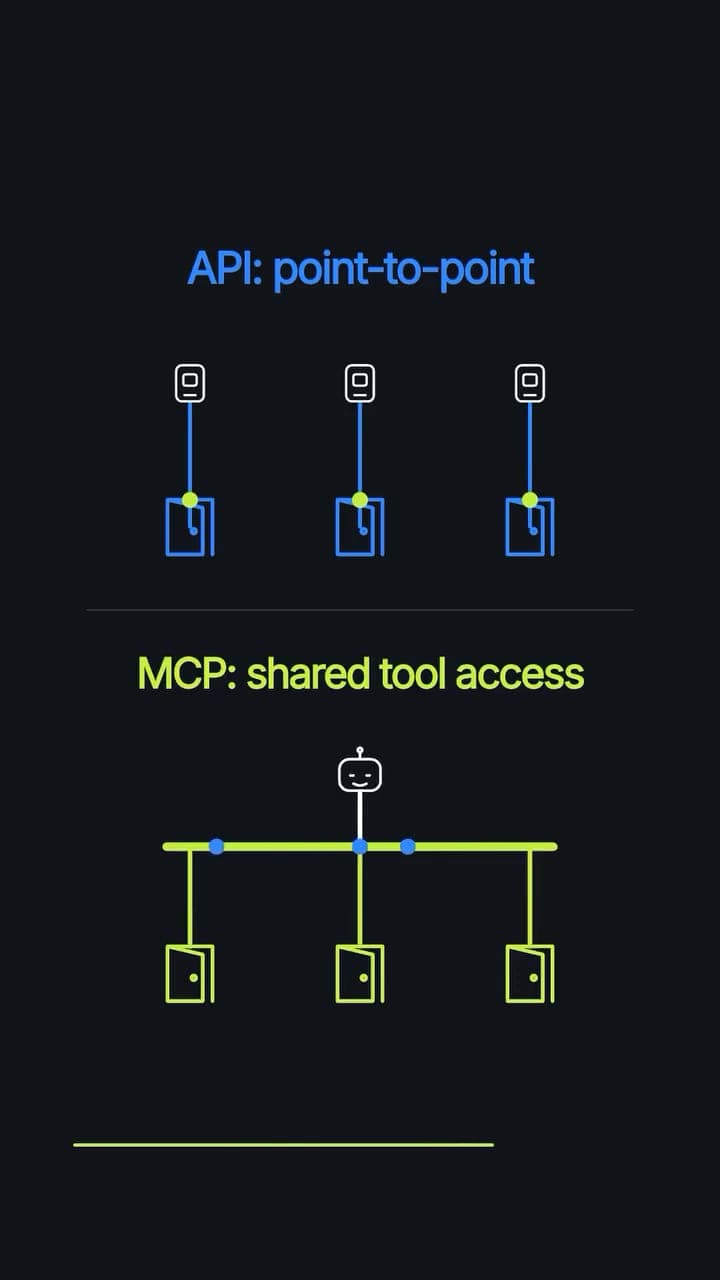
An API, or application programming interface, lets software request data or perform actions in another system, like checking the weather or creating a calendar event. It is a point-to-point connection: one app, one service, one agreed way of asking. Each API has its own addresses, inputs and rules, so each connection is built for that service.
What MCP adds
MCP, the Model Context Protocol, gives AI applications a standard way to discover available tools and data, understand their inputs, and use them. An MCP server exposes tools, such as a calendar tool or a files tool, and any AI app that speaks MCP can find and call them the same way. Instead of a separate custom connection for every service, the assistant gets shared access to many tools through one common protocol.
One request, two paths
Take a simple request: "Show me tomorrow's meetings."
- With a direct API integration, the AI uses a custom connection to your calendar.
- With MCP, it uses a calendar tool exposed by an MCP server, which may call that same API behind the scenes.
So the chain often looks like this: the AI app talks to an MCP server, the MCP server calls an API, and the API reaches the service.
APIs provide access. MCP standardizes how AI connects to that access.
Why it matters
As assistants take on more tasks, they need to reach more tools, and building a custom connection for every pairing of AI app and service does not scale well. With a shared standard, a tool can be exposed once and used by any compatible AI app, while the APIs underneath keep doing the actual work. Knowing the difference also makes product news easier to read: MCP support does not replace an API. It usually sits on top of one.