How semantic caching reuses AI answers
Semantic caching matches questions by meaning, not exact words, so an AI app can reuse a stored answer and skip a slow, costly model call.
Key takeaways
Traditional caches need an exact key match; semantic caches look for similar meaning.
Questions become embeddings: lists of numbers that represent their meaning.
A close enough match with a still-valid answer is reused instead of calling the AI.
Similar questions can need different answers, so check context and freshness too.
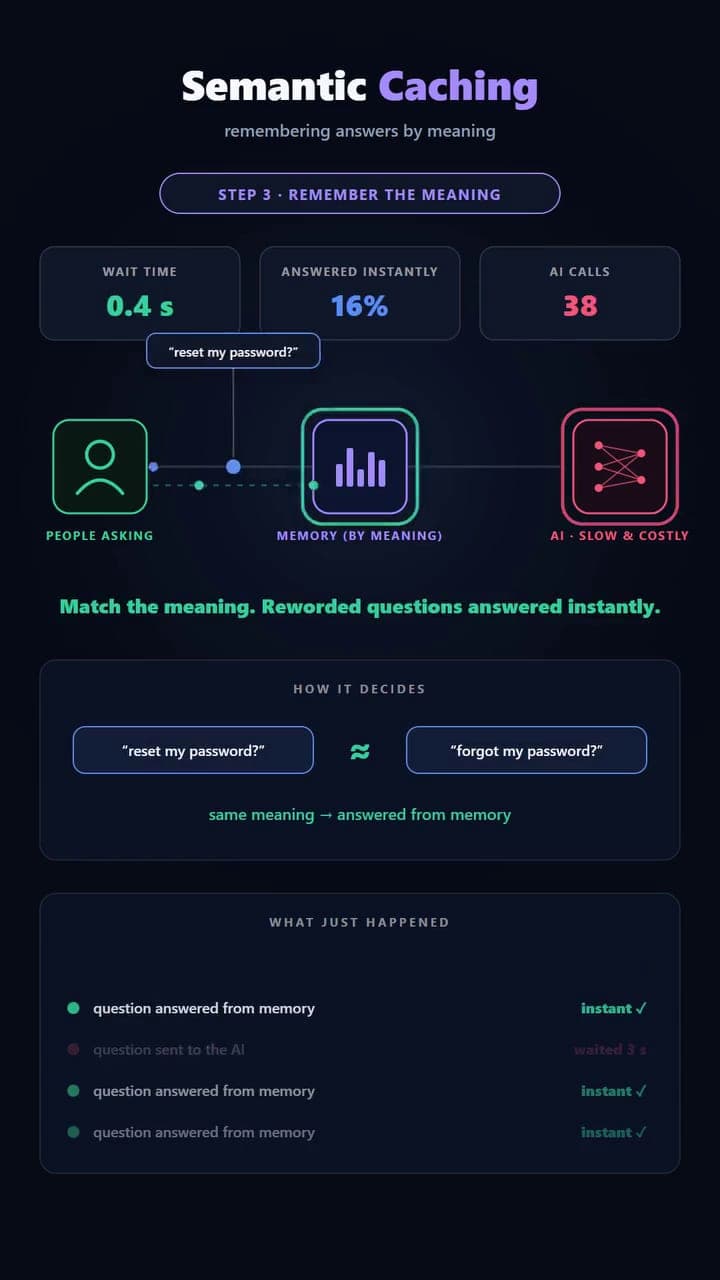
"How do I reset my password?" and "I forgot my password. How do I change it?" use different words, but they are the same question. Does an AI need to answer it twice? Every call to a language model takes time and costs money, so reusing a good answer is worth a lot. That is the job of semantic caching.
Exact words vs meaning
A cache stores answers so they can be served again without redoing the work. Traditional caching usually needs an exact match in the cache key: change one word and it counts as a brand new question. Semantic caching looks for similar meaning instead.
How it works
- Your question becomes an embedding: a list of numbers representing its meaning. Questions that mean similar things end up with similar numbers.
- The system compares it with the embeddings of previously answered questions.
- If a match meets its similarity threshold and the stored answer is still valid, it reuses that answer.
- Otherwise, the AI generates a new response, which can be cached for later.
The result: faster replies, fewer AI calls and lower costs.
The catch
Similar questions do not always deserve the same answer. "Can I cancel?" and "Can I cancel without a fee?" are close in meaning, but the difference matters. Set the threshold too loose and people get answers to questions they did not ask. Set it too strict and the cache rarely helps.
Good semantic caching checks context, permissions and freshness, not just similarity. An answer about one customer's account should never be served to another, and an answer about yesterday's prices may already be out of date.
Why it matters
Help desks and support bots hear the same questions phrased in many different ways. Semantic caching lets an AI app answer those instantly while saving model calls for questions that are genuinely new. Done carefully, people get quicker replies and the app spends less, without anyone getting the wrong answer.